What are Reporting Resources?
By Rachel Layne
Voting machines have been a source of concern at least since “hanging chads” in Florida stood in the balance of the contested 2000 presidential election. And despite legislative and technological changes since then, they remain controversial as the U.S. prepares for midterm elections this fall.
This guide covers the equipment, technology, and procedures used to count votes in U.S. elections. We’ll look at how ballots are tallied, checked, re-checked, and audited—all within a chain of custody set and maintained by local and state election officials who oversee elections in more than 10,000 election jurisdictions across the country.
After President Donald Trump lost re-election in 2020, voting technology became central to conspiracy theories and misinformation about the results of that election. A leading voting machine manufacturer, Dominion Voting Systems, reached a $787 million settlement with Fox News in a defamation lawsuit over false allegations that its machines wrongly “flipped” votes from Trump to Biden. Recently, President Trump and some of his supporters have revived the disproven assertions that voting machines helped sway the 2020 presidential election.
Journalists can navigate claims and conspiracy theories by understanding what scientific research says about fraud, the resiliency of the voting system in the United States, and how exactly local officials run elections, including by testing and auditing votes tabulated by machines.
Here are a couple more reasons why it’s especially important to understand how voting machines work and how to evaluate concerns about them during the 2026 midterm elections:
To understand federal influence on voting machines, it’s helpful to have a brief primer on election law.
Article I of the U.S. Constitution gives the responsibility for overseeing federal elections to the states, while allowing Congress some latitude to create some regulations.
Congress in 2002 passed the Help America Vote Act (HAVA) in the aftermath of the Bush vs. Gore 2000 presidential election, in which the results were delayed by discrepancies from punchcard ballots in Florida, and a sharply divided U.S. Supreme Court intervened. Replacing these systems was one of the purposes of HAVA, and punch cards are no longer in use.
Under the 2002 law, Congress created the U.S. Election Assistance Commission (EAC), which in turn developed voting machine certification guidelines, known as Voluntary Voting System Guidelines, or VVSG for short.
These guidelines are voluntary at a federal level, but some states codified VVSG guidelines with their own laws mandating machines comply with the EAC standards and be certified in order to be used for elections. All states have some systems or procedures in place to ensure confidence in their voting machines. The National Conference of State Legislatures offers links to state-level details about certification processes.
Machines are submitted by manufacturers to testing laboratories that the federal government designates.
Municipalities and states are responsible for purchasing, vetting, and running these machines securely and accurately. Many take additional steps to test the machines and verify they are counting votes accurately.
Local control over elections is one reason voting equipment can vary widely depending on where citizens vote.
Verified Voting, a nonpartisan, nonprofit organization that promotes “the responsible use of technology in elections,” offers a breakdown of the voting equipment that will be used in the 2026 midterm elections:
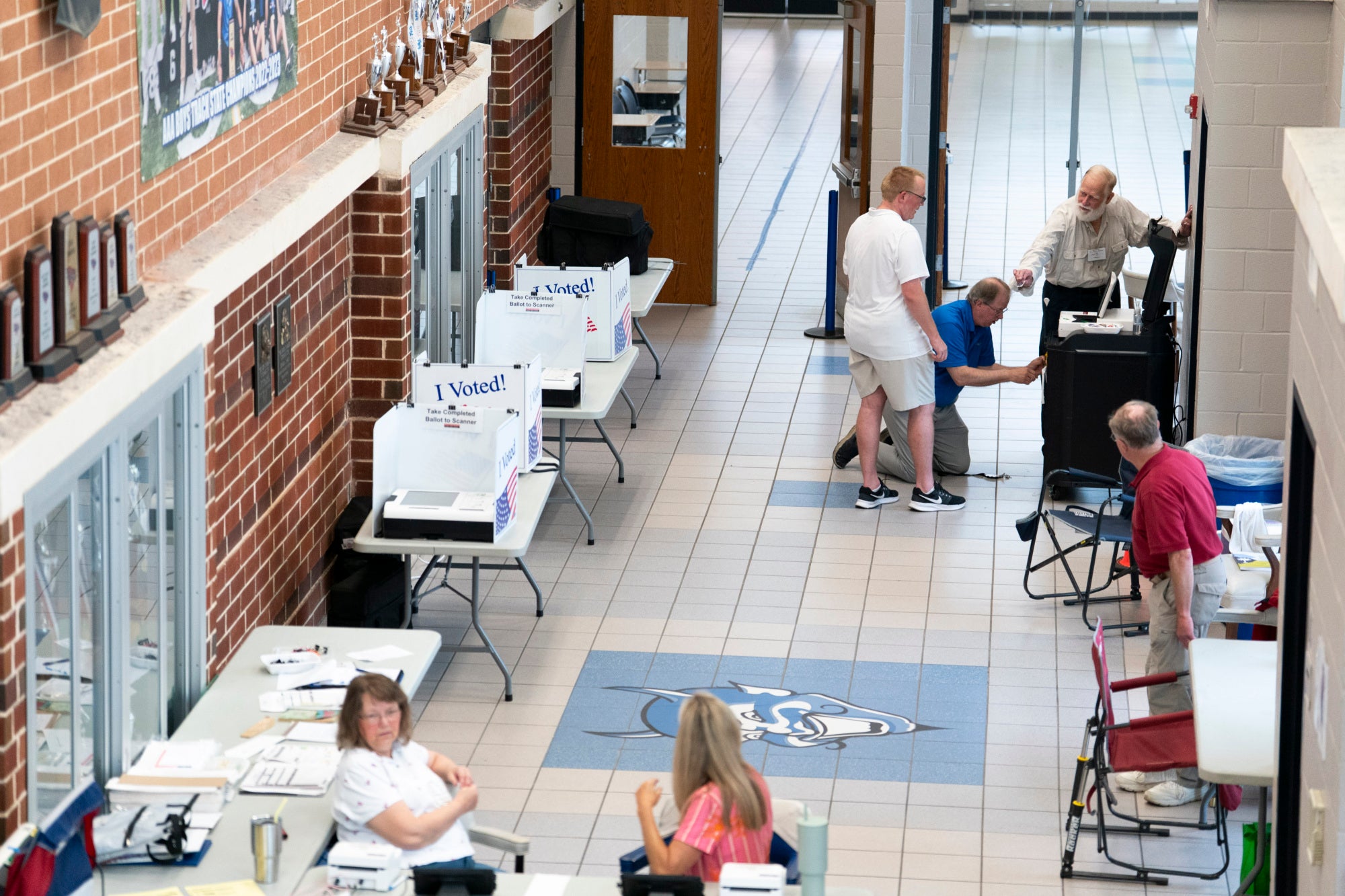
Many jurisdictions employ a combination of hand-marked ballots and BMDs, but some now use BMDs for all in-person votes. Some BMDs mark pre-printed ballots, while others print summaries of voter selections; voters get this printout so they can verify their choices before the ballot is sent on for tabulation and to create a paper trail.
These printouts can also include barcodes or QR codes that machines then scan rather than scanning the marked choices. Verified Voting has a map showing which states and jurisdictions encode voter selections this way.
Some critics have flagged this as a potential security risk, arguing that because some machines scanned the QR codes, not the plain-language part of the ballot where voters review their choices before the ballot is tabulated, the QR codes presented a risk. Several states have responded to these concerns.
Colorado, for example, banned QR codes used by ballot marking devices in 2019, opting instead for a system that printed out a paper record identical to voters’ original ballot choices. That change was certified in 2023 and is now used in Colorado, Michigan and Nevada.
Georgia in 2024 passed a law that would have banned the use of QR codes on ballots beginning July 1, 2026, but on June 24, 2026, the state passed a bill delaying the ban until 2028, allowing more time to update systems.
Verified Voting has an interactive map with information about the type of voting equipment used in each county, as well as the manufacturer of that equipment.
Voting machines are manufactured by several companies including Election Systems & Software (ES&S), Smartmatic, and Liberty Vote, formerly known as Dominion.
Before voting and counting takes place, local election officials and poll workers go through multiple test procedures to make sure the system, including its individual machines, is working properly, has been certified depending on the state, and is secure. That includes Logic and Accuracy Testing (LAT), in which local election officials feed test ballots into each voting machine to be sure the machine accurately counts votes for each candidate before election day. LAT procedures vary by jurisdiction and equipment.
Once voting ends and ballots are counted, most states require and conduct tabulation audits to check the vote totals before an election is certified. That’s one reason results are labeled “unofficial“ on election night.
A growing number of states also perform a kind of post-election audit called a Risk Limiting Audit (RLA) to verify that specific contest outcomes are correct. To find out what type of audits your jurisdiction uses, contact your Secretary of State’s office or the official responsible for elections in your coverage area.
According to the National Conference of State Legislatures, 36 states and Washington, D.C., require a traditional post-election tabulation audit. Three—Ohio, Oregon, and Washington—give counties the option of using a risk-limiting audit instead, while Indiana, Kentucky, Michigan, New Jersey, Pennsylvania, and Texas have embarked on RLA pilot programs.
As of April, seven states require RLAs by law: Georgia, Colorado, Maine, Maryland, Nevada, Rhode Island, and Virginia. Other states have post-election audits that fall outside these categories, the NCSL notes.
According to the EAC, “traditional” audits look to answer the question: “Did the vote tabulators function correctly?” while RLAs look to answer, “is the reported outcome correct?”
RLAs examine the contest results by checking a sample of ballots “validly cast in that contest,” according to Verified Voting. Checking this way is yet another layer to verify voting tabulations are accurate. Risk-limiting audits offer statistically sound methods that can be more efficient than tabulation audits or full hand recounts, according to Verified Voting.
“Just from a scientific perspective of consistent skepticism, tabulation audits are key, because we don’t want to assume that the tabulators did what they were supposed to,” says Mark Lindeman, Verified Voting’s policy and strategy director. “If we’re conducting a risk limiting audit, we’re looking specifically for high assurance that the outcome was correct.”
Historically there have been genuine attempts to alter voting results or steal voter information, including cyberattacks. But researchers say that even when real attacks occur, redundancies like paper ballots and RLAs help identify, catch, and correct possible damage, making elections more secure.
And while voting machines do occasionally malfunction, a topic local news reporters are likely to cover when it occurs, it’s important to explain that equipment malfunctions and human error are not the same as fraud.
Scientific studies can help journalists vet claims and concerns about voting machines in the lead-up to the 2026 midterms. Research to date suggests:
Claims about voting machine fraud in the 2020 election are not supported by scientific evidence.
In the past few years, courts have issued more than 60 rulings dismissing a broad array of claims of fraud in the 2020 U.S. election, including alleged vote “flipping.” A 2021 analysis from the Stanford-MIT Elections project outlines the 82 lawsuits filed tied to the 2020 elections, 80 of them by Republicans. Yet officials aligned with the Trump administration continue to make disproven claims.
Multiple studies examine and find no evidence for the claim that voting machines “flipped” votes from Donald Trump to Joe Biden in the 2020 presidential election.
A May 2025 peer-reviewed study in the Proceedings of the National Academy of Sciences led by election scientist Samuel Baltz examined audits of the 2020 election in 27 states. The authors find “clear and consistent evidence that the vote count was exceptionally accurate” after analyzing more than 71.7 million votes from 856 regional governments in those states.
Post-election audits “shifted the net presidential vote count by only about 0.007%, with similarly minuscule errors across all major types of electoral contests,” the authors write.
Claims of systemic fraud, including alleged manipulation of voting machines during the 2020 election, aren’t “even remotely convincing,” including since-disproven claims that some machines switched votes to Biden from Trump, finds a 2021 peer-reviewed study in the Proceedings of the National Academy of Sciences by Andrew C. Eggers from the University of Chicago and two Stanford University researchers, Haritz Garro and Justin Grimmer.
“The common logic behind these claims is that, if the election were fairly conducted, some feature of the observed 2020 election result would be unlikely or impossible,” the authors write. “In each case, we find that the purportedly anomalous fact is either not a fact or not anomalous.”
Paper ballots are a powerful security safeguard.
Paper ballots create a record used in audits and recounts as well as evidence in legal proceedings. Coupled with an intricate number of steps and safeguards local election workers use to secure ballots, the records help settle disputes and catch mistakes.Paper ballots “are by far the most important safeguard to keep in mind. It’s also an area where there has been incredible progress very quickly,” says Derek Tisler, counsel and manager in elections and government program at The Brennan Center for Justice at New York University. “It’s not the only thing, of course, that helps protect voting system security. But more than anything else, if you have this independent record, there is something that you can go to if there is ever a doubt about the accuracy of the electronic count.”
Scientists, experts, and election officials came together after the 2016 election to underscore that point in a National Academies of Sciences, Engineering and Medicine 2018 report, which studied the voting process, including all kinds of ballots and machines, and made recommendations.
Some 98% of ballots in the 2024 federal election were in voter-verifiable paper ballot form, up from roughly 93% in the 2020 election. That is, voters either marked the ballot directly or were able to examine paper ballots before casting their vote.
“One of the things that we really needed and really wanted was a voter-verified paper ballot, and now they’re producing that. That’s the most important characteristic,” says Juan Gilbert, a professor in the University of Florida’s Computer and Information Science and Engineering Department, and one of the contributors to the 2018 report. “Voters can actually verify their paper ballot, and as long as we have that, we have a pretty secure environment.”
Voting machine counts are more accurate than hand counts.
In the 2020 election and in years since, some local officials have advocated for hand-counting ballots as a way of ensuring accuracy in vote-counting. Several peer-reviewed studies show that machine counting is both faster and more accurate than hand-counting.
In a 2022 op-ed in the Washington Post, Charles Stewart III, a founder of the Massachusetts Institute Of Technology’s MIT Election Lab, points to two studies he co-authored, one examining elections in New Hampshire and one looking at Wisconsin. Both analyze data and parse whether machines or people count more accurately.
“These studies show that both hand counting and scanners can be very accurate, but scanners are better,” Stewart wrote.“They also found that when rare, large discrepancies do arise, they occur because of poll workers’ decisions, such as stopping counting because they were tired or not counting write-in ballots considered irrelevant.”
Today, hand-counting is used to tally results in fewer than 0.17% of registered voters, usually in jurisdictions with fewer than 10,000 people.
Regardless of voting system, local election officials and poll workers generally perform checks and audits before, during, and after counting to ensure a secure count and to catch mistakes.
Real security risks do exist – but so do safeguards.
There have been documented attempts to alter voting results or hack into systems in attempts to garner information, including cyberattacks. But researchers say that even when real attacks occur, redundancies like paper ballots help identify, catch, and correct possible damage.
J. Alex Halderman, a computer scientist from the University of Michigan, found vulnerabilities—but no fraud—in Michigan’s Antrim County’s initial publishing of incorrect vote totals in the 2020 general election, which were later corrected. Michigan, which hired the researcher to examine the county’s results, ultimately released Halderman’s report, which tied the mistakes in a preliminary voting count to human error.
Haldeman also examined ballot marking machines in Georgia, in 2022. His scientific analysis also found potential vulnerabilities in the state’s system, but noted that Georgia’s votes in the 2020 election were not tampered with or compromised.
A 2022 report from MITRE, a nonprofit government advisory firm hired by Dominion to examine Halderman’s findings. Halderman conducted three months of tests with “unlimited access,” a statement from Georgia Secretary of State Brad Raffensperger said.
“The risks outlined in the researcher’s report are theoretical and imaginary,” said Raffensperger. “Our security measures are real and mitigate all of them.”
The University of Michigan in 2024 published a Q&A interview with Halderman to explain.
Halderman also says his work has been mis-used in conspiracy theories.
“There’s not much that I can do to change what people are going to say about the science. It’s my job to be figuring out what’s true and to be communicating that to the public accurately,” he said in the 2024 interview. “Of course, it hurts, and it’s personally offensive when my work is the convenient vehicle for telling lies. But the people who want to tell lies about the last election are going to tell lies with or without my work.”
Showing people how audits work can bolster trust in the electoral process.
Verified Voting has a video explaining the Risk Limiting Audit procedure to election officials and the public.
A May 2026 study published in Political Behavior by Georgia Institute of Technology Professor Ryan Shandler, who conducted experimental research on a nationally representative sample of American adults, found that brief exposure to that video four weeks before the 2024 election built confidence in the electoral process—even when they were later exposed to news coverage about real cyberattacks closer to Election Day.
“The aim of the ‘inoculation’ was to try and prevent people from making an erroneous leap of logic, which is that because there was a cyberattack, the result of the election should be called into question,” Shandler says. “Yes, there are attacks, and yes, the systems are vulnerable, but we’ve got a great deal of redundancies in place to prevent that point A from getting to point B. The most worrying threat is that people unnecessarily lose faith in democratic legitimacy, and that’s what we want to avoid.”
We asked several researchers who study voting and voting machines to share reporting tips and story ideas for local journalists covering the 2026 midterm elections. Here’s what they said:
Get to know your local election officials and explain what they do.
It’s important for journalists to build relationships with local election officials long before Election Day, so that voices from primary sources like election officials are included, says Georgetown University’s Thessalia Merivaki, who has been tracking election officials’ communications since 2020. Ask officials for permission to attend logic and accuracy training ahead of the election, she advises, and tell your audience about it.
“Have that conversation with election officers,” Merivaki says. “Report that ‘we went and we visited this election office and spoke with X; we asked specifically how elections are secure.’”
As Shandler’s 2026 study shows, even brief exposure to how the electoral process works, including what officials do to bolster security, helps build confidence in elections.
“Obviously, every state’s laws vary on this, but you do see across the U.S. logic and accuracy testing beforehand and some form of post-election audit after the process,” the Brennan Center’s Tisler says.
Find out about certification for the voting machines in your news coverage area.
It’s important to ask how and what kind of certification voting machines have in the jurisdiction journalists are covering, says University of Florida’s Gilbert. This report from the Congressional Research Service outlines the process for certification at the federal level. It includes how often machines should be replaced and the pace at which VVSG 2.0 certifications—the latest version of certification standards—are proceeding. It also includes cost estimates and budgets.
Some 37 states and the District of Columbia have laws or rules that require some aspect of the federal testing and certification program for voting machines, according to the National Conference of State Legislatures. Other states that don’t use the federal program have their own standards. Others, like Alaska, don’t have standards codified into law but use federally certified machines.
Others go beyond federal certification standards. California law, for instance, mandates standards for voting systems that exceed the voluntary federal certification rules, while Florida has its own Bureau of Voting Systems Certification responsible for standards and certification. The EAC details each state’s policy as of 2023.
The EAC’s website also has information about which machines are certified and which are undergoing certification testing.
With proposed cuts in the EAC’s budget, more funding to replace voting machines may be required from the states and localities. A report from CRS outlines the history of federal funding under HAVA and the EAC for context. It also includes funding and grant details for each state.
The average lifespan of a voting machine tends to be about a decade, and the process to certify at the federal level can be lengthy and expensive. Tisler recommends checking Verified Voting’s database to find out what machines your state or municipality uses. You can also read about the certification process on the EAC website.
When people make claims about voting machines, including both allegations of fraud and possible legitimate errors, ask for evidence.
“Whenever there’s an allegation, if you’re a reporter, you should ask: ‘Do you have evidence?’” says University of Florida’s Gilbert. “Listen to what people say. When you hear the words ‘could,’ ‘should’ and ‘I believe’ … those aren’t words of confidence, of evidence.”
And if the person presenting the claim doesn’t have the evidence to back it up, ask them how you would get that evidence, Gilbert suggests.
“What we need to do is move in a direction of evidence-based inquiry,” Gilbert says. “And we need to move the nation to say if someone makes a claim and they don’t have evidence, they should tell us how to acquire that evidence.”
The Brennan Center for Justice at New York University studies voting rights and advocates for fewer barriers and more equitable access to voting. They follow elections and related issues closely.
The Congressional Research Service, run through the Library of Congress, researches and creates nonpartisan reports for members of Congress on a wide variety of issues. For this report, we used those related to voting machines, election laws and regulations on the federal level.
The United States Election Assistance Commission, the agency created by HAVA to assist states with elections including technology, regularly posts updates on certification and other practices.
The MIT Election Data Science Lab: This research center at the Massachusetts Institute of Technology, founded by political scientist Charles Stewart III, collects, analyzes, and shares data on U.S. elections.
National Conference of State Legislatures: the NCSL was created by state legislatures in 1975. It tracks legislation and policy at the state level. They offer detailed explainers about elections, voting systems, certification, and other election-related topics.
National Association of Secretaries of State: This bipartisan organization meets to discuss issues that generally fall under the secretary of state role, or in some states when it comes to voting, other officials that that state designates as in charge of elections, such as lieutenant governors. Their media campaign #Trustedinfo can be found here, along with resources for each state.
The Ohio State University’s Election Cases Tracker is a sortable database that makes it easier to find court cases related to elections and voting machines.
Verified Voting was founded in 2004 by computer scientists. It has the most detailed and widely used database on election machines and other processes surrounding how the United States runs its elections. Researchers and election officials locally, in states, and nationally depend on their data, training, and guidance materials.
VoteBeat: Votebeat is a nonpartisan, nonprofit news outlet dedicated solely to election coverage in the United States. It is owned by Civic News Company. Their “journalism is rooted in deep expertise and based in the states rather than Washington — because states are the ones that run elections.”
Rachel Layne is a Boston-based freelance journalist whose work has appeared in outlets including CBS News, CQ Researcher, The Journalist’s Resource, HBS Working Knowledge and USA Today. Previously she spent 20 years at Bloomberg News, where she covered multinational corporations, among other roles. She is also an adjunct instructor in Emerson College’s journalism department.
This is a list of the research papers, reports, and experts we consulted for this journalism guide and why we chose them.
University of Florida’s Juan E. Gilbert is a distinguished professor in the university’s Computer and Information Science and Engineering Department and one of the contributors to the National Academies of Sciences, Engineering and Medicine 2018 report. Gilbert runs the Computing for Social Good Lab and works on solutions to voting issues, including voting machine technology designed to be tamper-proof. We spoke to him for his perspective on technology and process.
Mark Lindeman is Verified Voting’s policy and strategy director and a political scientist who has done extensive work on voting and elections, particularly Risk Limiting Audits. We spoke to him about those audits and other voting issues, such as training local officials.
Georgetown University’s Thessalia Merivaki is an associate teaching professor at the McCourt School of Public Policy who has been tracking election officials’ communications since 2020. She is also an associate research professor at the Massive Data Institute and a resident fellow at the Center for Democracy & Technology. She is a member of the U.S. Election Team of the Carter Center. We spoke to her because of her expertise in and research on how voting officials communicate.
Georgia Institute of Technology’s Ryan Shandler focuses on how cyber threats influence human behavior. His recent study on using a Verified Voting video to “innoculate” how voters view cybersecurity threats examines how information on voting procedures impacts public perception and behavior—even when such threats are real.
Derek Tisler is counsel and manager at the Brennan Center for Justice’s government program at New York University. He is the author of many reports for the center, including A State Agenda for Election Security and Resiliency. We spoke to him about election security and the veracity of sources for election security information.
“Learning from Recounts”
Stephen Ansolabehere, Barry C. Burden, Kenneth R. Mayer, and Charles Stewart, III Election Law Journal.This research article traces recounts in Wisconsin’s Supreme Court election and the 2016 presidential election to examine whether hand count or machine counts are more accurate. Stewart is a founder of the Massachusetts Institute of Technology’s Election Lab and studies elections.
“Ballot-Marking Devices Cannot Ensure the Will of the Voters”
Andrew W. Appel, Richard A. DeMillo, and Philip B. Stark, Election Law Journal.This 2020 study looks at ballot marking devices, advocating that improvements are needed to reduce risk and that BMDs “should not be used by voters who can hand mark paper ballots.”
“Audits of the 2020 American election show an accurate vote count”
Samuel Baltz, Fernanda Gonzalez, Kevin Guo, Jacob Jaffe, and Charles Stewart, III PNAS May 2025.This study builds and examines a comprehensive national dataset of votes in the 2020 election, giving a broad picture of the election’s legitimacy just as accusations of fraud resurface in the political landscape..
“Securing the Vote: Protecting American Democracy”
Lee C. Bollinger, Michael A. McRobbie, Andrew W. Appel, Josh Benaloh, Karen Cook, Dana DeBeauvoir, Moon Duchin, Juan E. Gilbert, Susan L. Graham, Neal Kelley, Kevin J. Kennedy, Nathaniel Persily, Ronald L. Rivest, Charles Stewart III. September 2018. Report for the National Academies of Sciences, Engineering and Medicine, 2018.This comprehensive report examines the entire voting process and makes recommendations on how to improve voting security, including for machines.
“Hacking Voters’ Trust in Democracy: Panel Evidence on Safeguarding Confidence in Election Integrity,”
Ryan Shandler, Iris Ong, Olivia Leu and Anthony DeMattee, Political Behavior, May 2026.This study takes a close look at messaging about real cyber attacks and voter confidence.
“When Election Officials Speak, Do Voters Listen? Trust-Building Communications, Information Seeking, and Voter Confidence in the 2022 U.S. Midterm Elections,”
Mara Suttmann-Lea,Thessalia Merivaki and Rachel Orey, Political Communication April 2025.This study looks at how election officials moved to build trust with voters exposed to a sea of disinformation and misinformation.
“Beware of Novel Claims of 2020 Election Fraud”
Derek Tisler, Lawrence Norden, research brief, the Brennan Center for Justice, March 2026.This brief examines emerging and re-emerging claims of voting fraud by the Trump administration, outlining why the public should “approach these reports with extreme skepticism.”