

What are Reporting Resources?
Updated September 8, 2026, to report passage of a stop-gap funding bill that delays implementation of the rule through December 11, 2026.
Updated July 30, 2026, to clarify the volume of comments submitted through regulations.gov regarding the proposed rule during the comment period.
By Kerry Dooley Young
In the lead-up to the 2026 midterm elections, the Trump administration is fast-tracking a proposal to give political appointees much more control over federal funding for scientific research. It’s a move that could affect hundreds of billions of dollars in grant funding at institutions all over the United States, and it’s something local journalists need to understand.
How widespread would the impact of that proposal be? Thousands of universities and other research organizations in all 50 states could be directly affected, with implications for state and local economies.
Just type the name of almost any large U.S. town or city into the NIH RePORTER, a publicly available federal funding database, and you will likely discover millions of research dollars given to universities, nonprofit organizations and companies in your community. This interactive database, popular with journalists, tracks National Institutes of Health (NIH) grants, considered the lifeblood of medical research with about $35.3 billion in annual awards for fiscal 2025.
Winning federal grant money through a competitive process has long been crucial for scientists pursuing new ways to treat and prevent diseases, improve weather forecasting, guarantee clean water, examine the effects of economic policies, and better understand a long list of other societal challenges.
Historically, a key component of the selection process has been peer review—when independent experts in a specific scientific field help evaluate and determine which projects deserve to be funded based on their technical merits and potential scientific impact. NIH and other federal organizations, such as the Environmental Protection Agency, rely on scientists and other experts, often those working in academia, to help them assess grant proposals.
While the process isn’t perfect, peer review has helped create an effective and productive system for deciding which projects to fund, scientists and engineers say.
On May 29, the administration published a plan to quickly and dramatically change the framework used to decide which research and researchers can qualify for grants, downplaying the role of peer review. The Office of Management and Budget (OMB), in conjunction with more than 40 federal agencies, proposed a sweeping rule that would give political appointees more direct influence in deciding who gets grants.
Under the proposed rule:
The proposal, including the lesser role for peer review, has set off alarms in the scientific community.
OMB set a 45-day window for the public to comment on the rule proposal, with a July 13 deadline. The office intended to have the rule in place by Oct. 1, but on Sept. 1 Congress passed a short-term funding bill, signed into law Sept. 2, that prohibits implementation of the rule through Dec. 11.
At least 58,750 individual comments have been posted to the rulemaking docket on the regulations.gov website, reflecting deep concern about a bid to suddenly shift control of research money away from experienced scientists.
The rule’s “comments received” counter on regulations.gov shows that nearly 497,000 comments were submitted before the deadline, a number that was widely reported in news stories about the proposal and initially reported in this guide. But subsequent reporting indicates that figure is likely inflated by a quirk in how regulations.gov tracks submissions, rather than a true count of individual comments, as data scientist Abigail Haddad and open science advocate Christopher Marcum reported in a July 17 post on Haddad’s Substack, The Present of Coding.
Science followed up in a July 20 article by Jocelyn Kaiser, explaining, “The comment form asks a submitter who uploads their comment as an attachment (instead of typing it into a box) whether the comment represents more than one person or entity. If the submitter clicks ‘yes,’ they’re then asked how many ‘persons/entities’ the comment represents and can enter a number as high as 999,999 that is automatically added to the comment count. That allows savvy submitters to ‘game’ the comment number, Haddad and Marcum write in their 17 July post.”
Regulations.gov explains how comments are counted and posted in its “frequently asked questions” section.
Editor’s note: SciLine is an editorially independent program of the American Association for the Advancement of Science, the world’s largest multi-disciplinary scientific society and publisher of the Science family of journals. In a June 2 statement, AAAS said that the proposed OMB changes would politicize research and harm scientific discovery. It has urged its member scientists to use the comment process to talk about how the OMB changes would impact their research.
The proposed rule could become an issue in the 2026 U.S. midterm elections.
OMB Director Russell Vought has taken the unusual step of publicly attacking critics of the pending proposal during the comment period. He’s posted on X from his verified account, and then the official Office of Management and Budget account has retweeted his posts.
In a June 13 post, Vought portrayed his proposal as a bid to stop “spending that is woke, wasteful, and contra to the policies of the Trump administration thru the NGOs.”
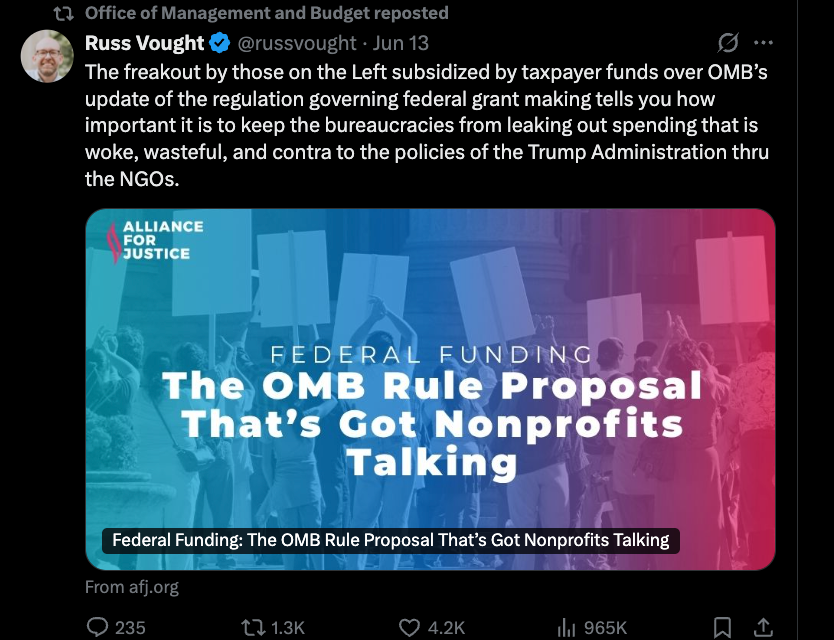
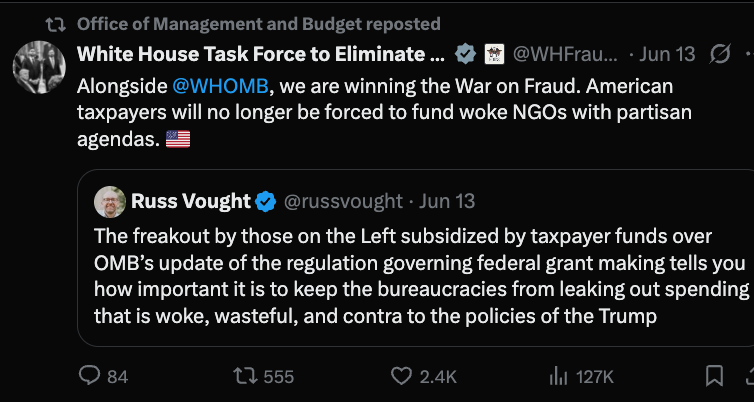
Backers of the OMB proposal include the Heritage Foundation, the prominent right-wing think tank that produced the controversial Project 2025 report, which Vought co-authored while serving as vice president of Heritage’s lobbying arm, Heritage Action for America.
Jonathan Butcher, acting director for the Heritage Foundation’s Center for Education Policy, describes the proposed rule as an effort to unweave Diversity, Equity and Inclusion (DEI) initiatives from federal programs.
“I see it from the perspective of equality under the law, and that the federal government is removing racial preferences from its grant programs,” he said in an interview.
But one of the most powerful Republicans in Congress has asked Vought to reconsider the speed at which he intends to put the rule in place and its scope.
“The proposed revisions are the most significant changes proposed to the Guidance since it was adopted,” Senate Appropriations Committee Chairwoman Susan Collins (R-Maine) wrote. “Yet, OMB has provided stakeholders only 45 days to comment on the rule, with a stated intent to finalize the rule by October 1, 2026, to align with the upcoming fiscal year.”
Collins said in her letter that the rule “would undermine the objective that the Federal government fund scientific and biomedical research projects based on scientific merit and value, rather than political ideology.”
Three House Democrats—Rep. Frank Pallone of New Jersey, Diana DeGette of Colorado, and Yvette Clarke of New York—have described the OMB proposal as an “obvious power grab” that “threatens to inflict severe harm on the nation’s biomedical research enterprise by usurping the critical role of scientific experts in the approval and funding of grants.
“We fear this rule will lead to fewer cures, fewer clinical trials, and more exposure to dangerous public health hazards,” the three wrote in a June 22 letter to NIH Director Jay Bhattacharya.
Meanwhile, on June 24, the National Science Foundation introduced a separate proposal to revise how it reviews, awards, and manages research grants through its Proposal and Award Policies and Procedures Guide. The guidance accompanying the NSF proposal notes “aligning with the proposed revisions to the Office of Management and Budget’s (OMB) Uniform Guidance…through the proposed rule published on May 29, 2026.”
Rep. Zoe Lofgren (D-Calif.) objected in a June 29 letter to NSF Acting Director Brian Stone. “NSF jumping the gun and issuing proposed PAPPG amendments before the OMB rule is finalized – let alone before the public comment period has concluded – is a clear sign that the Administration in general, and NSF specifically, have no interest in legitimately considering the input of the impacted community,” she wrote.
Scientists all over the country have raised concerns about the diminished role of peer review in the OMB proposal. They’ve also flagged a line in the proposal that says grant applicants “should commit to complying with administration policies, procedures, and guidance respecting Gold Standard Science..”
The term “gold standard science” has appeared in several government directives, including a presidential executive order, issued a week before the OMB proposal, titled “Restoring Gold Standard Science.”
“We must restore the American people’s faith in the scientific enterprise and institutions that create and apply scientific knowledge in service of the public good,” the order says.
The June 24 NSF proposal mentions “adherence to tenets of Gold Standard Science in proposals, as appropriate for the field of science and research modality” per the executive order.
“Gold standard” has been used informally among scientists, for decades, to describe specific high-quality research methods—doubled-blind randomized controlled trials are often described as the “gold standard” for whether a new medical treatment is safe and effective. But scientists say the White House clearly intends to add more politics into funding decisions. And prominent members of the scientific community have argued that politicians should not be in charge of gauging the quality of research.
Now we’ll look at how the government traditionally funds scientific research and OMB’s role in it, how the procedures OMB is proposing with this rule differ from the budget office’s usual approach, and how journalists can explore the impact of the proposed rule in their own communities.
First, let’s review how federal funding has worked historically.
The Constitution gives Congress what’s known as the power of the purse. Article 1 of the Constitution states, “No Money shall be drawn from the Treasury, but in Consequence of Appropriations made by Law.”
This means the House and Senate must pass laws to allow spending by federal agencies. These are known as appropriations bills. Congress almost always collaborates on appropriations with presidents, who sign these spending bills into law.
In President Donald Trump’s second term, there have been bids by his administration to make changes in spending that contradict enacted appropriations.
The U.S. federal government has been providing some funding for scientific research from its earliest days. For example, Congress in 1807 passed a bill, which President Thomas Jefferson signed, that provided $50,000 for surveying the coasts of the United States. In the decades that followed, Congress provided money for efforts to bolster scientific research with immediate practical applications, such as improving crop yields.
A major shift occurred following World War II.
In 1945, engineer and inventor Vannevar Bush gave President Harry S. Truman a report, titled “Science: The Endless Frontier,” which called for more investment in basic research.
“Basic research is performed without thought of practical ends. It results in general knowledge and an understanding of nature and its laws,” Bush wrote. “The scientist doing basic research may not be at all interested in the practical applications of his work, yet the further progress of industrial development would eventually stagnate if basic scientific research were long neglected.”
The report spurred the creation of the National Science Foundation and helped persuade Congress to start robustly funding what was then a fledgling NIH.
Historical research indicates the decision to invest in basic research made the United States an economic and scientific powerhouse, fueling innovations in medicine and technology that have improved lives of people around the world.
Federal funding for scientific research and development was about $192.2 billion in fiscal 2025, the budget year that began on Oct. 1, 2024, according to a recent report from the Congressional Research Service (CRS).
Most federal scientific research funding goes to projects led by people working at universities and companies, who compete to win grants.
The federal government has, over decades, repeatedly refined its approach for trying to make sure these grants are well spent.
Much of this oversight is done by OMB, which has expanded over the years in keeping with the growth of the federal government.
OMB began in 1921 as the Bureau of the Budget within the Treasury Department. In 1939, this bureau moved to what was then the newly created Executive Office of the President.
In 1974, Congress made the positions of OMB director and deputy director subject to Senate confirmation due to the power the people in these posts have to influence federal spending.
OMB’s significant clout derives from serving as a final decision maker about the operations of many federal programs. Federal laws passed by Congress generally provide agencies with funds and some overarching directions for spending them. Agencies then work out the fine details and devise plans for carrying out the work directed by Congress.
OMB gets the final say on many annual budget plans, often making substantial changes to the initial budget proposals submitted by leaders of federal agencies. That’s the “B” in OMB.
Less understood by the public, but arguably more influential, is OMB’s management role, which often gives it a final say on both formal federal regulations and less formal guidance documents that spell out how money can be allocated. That’s the “M” in OMB.
With regulations and guidance documents, OMB shapes the operations of not only the federal, state and local governments, but those of corporations and universities.
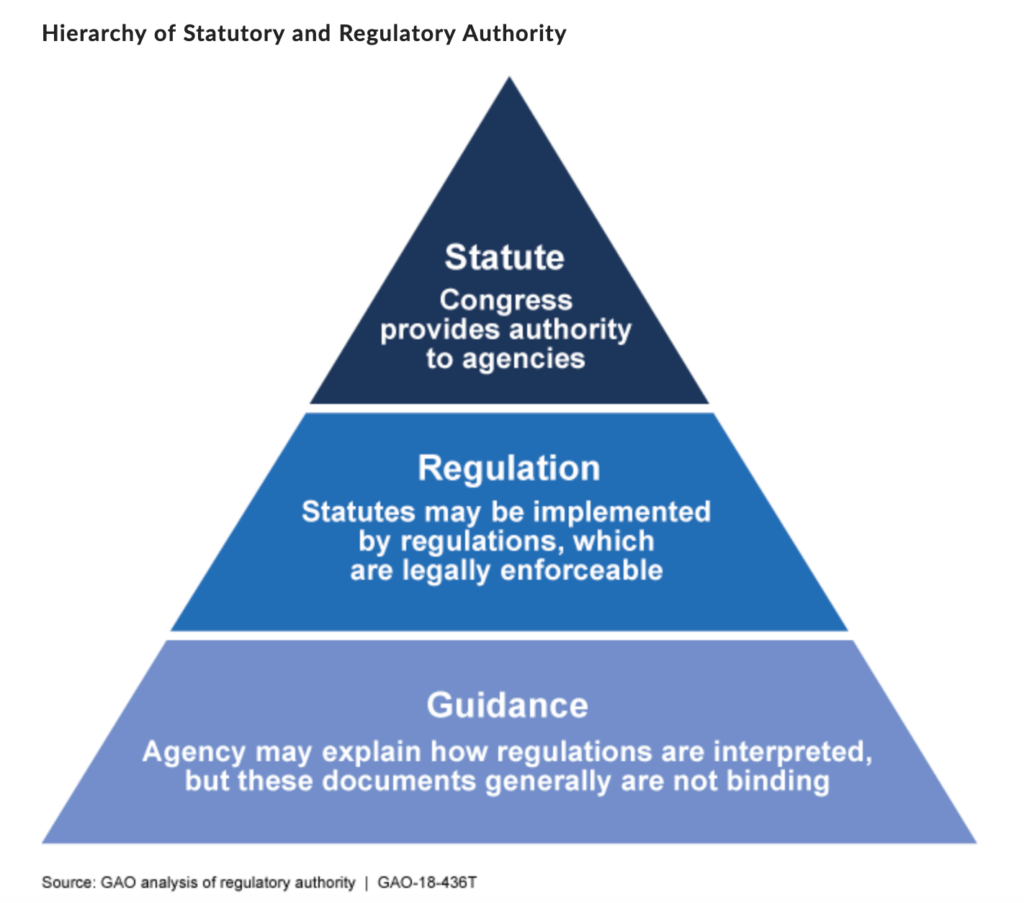
Congress passes laws that direct federal agencies to take action, but generally leaves it to the experts at agencies to figure out how to create new federal rules.
Agencies usually send their draft rules to OMB, which has its Office of Information and Regulatory Affairs (OIRA) examine these proposals.
Within OMB, the “OIRA exerts considerable influence over the content of regulations, ensuring that federal agencies’ actions are consistent with” presidents’ preferences, the Congressional Research Service wrote in a 2023 report.
In 2013, OMB published the Uniform Guidance, a governmentwide framework for administering federal research grants that attempted to consolidate several guidance documents into one.
OMB described the 2013 guidance document as the product of two years of collaboration with federal, state and local governments, tribal nations, universities, nonprofits and auditors.
Since then, OMB has updated the Uniform Guidance.
An update in 2020 emphasized performance metrics and added “a provision that required that procurements under federal awards should provide a preference for items produced in the United States to the greatest extent practicable,” according to a CRS report released last December.
A 2024 update addressed indirect costs for researchers and made clear that federal agencies may translate notices of funding opportunities for federal grants into languages other than English.
The proposed rule, were it to pass, would result in the most significant overhaul of the Uniform Guidance to date, making it much more powerful than it is now.
Among the most ardent supporters of increased presidential power is OMB Director Russell Vought, who also served as OMB director in Trump’s first term. Vought worked with the Heritage Foundation on its blueprint for its agenda for a second Trump administration, known as “Project 2025.”
“The modern conservative President’s task is to limit, control, and direct the executive branch on behalf of the American people,” Vought wrote in the Project 2025 report.
In addition to the substance of the proposed rule, many researchers object to the rapid pace at which OMB intends to make these changes.
Scientists such as Dr. Dara Norman, the president of the American Astronomical Society, have asked OMB for more time to review the proposal.
In a June 10 comment submitted to OMB, Norman said a 90-day or even 120-day comment period would be more appropriate than the current 45-day comment period because of the extensive changes sought in the proposed rule.
“It lists 120 revisions in numerous areas including the selection of grants, allowable cost structures and international collaboration, to name a few,” Norman wrote. “Such changes would be transformative to the manner in which the U.S. scientific enterprise operates, impacting how projects get funded, the manner in which they are carried out and the dissemination of their results, including in open-access, peer-reviewed journals.”
To understand how the unusually rapid four-month timeline given for Trump’s OMB proposal differs from the norm, consider that a recent, far-less extensive change to the Uniform Guidance was a 20-month process, stretching from a call for public feedback in February 2023 to publishing proposed changes that October, accepting comment on those changes, publishing a final proposed order in April 2024, to take effect in October 2024.
The potential ramifications of such sweeping changes to control of scientific research are an intensely local story.
Research projects of importance to particular demographic communities, geographical regions, or industries could be affected.
Leaders of any university or research institution in your community who rely on federal research dollars will likely have something to say about it, and so will individual scientists at those institutions. But keep in mind that some may be wary of talking openly about a political topic that’s directly tied to future funding opportunities. To find scientists who are likely to feel comfortable speaking on the record, look for those who already have commented publicly about the proposal.
And by its very nature, a proposal to insert more political control over scientific research is a political issue this year, too. Every House seat and 35 Senate seats are up in the 2026 mid-term elections.
Your audiences may be interested in whether lawmakers support or oppose OMB’s plan for greater direct White House control of grant funding. If this OMB rule is finalized, members of Congress will face persisting calls from the scientific community to block its implementation or to make the budget office revise it.
You can find a wealth of important context and story ideas about the ramifications of the proposed changes in the thousands of public comments about the proposed change, and in databases outlining the local projects that receive federal research funding:
Kerry Dooley Young is a freelance journalist based in Washington, D.C. Her work also has appeared in The Journalist’s Resource, STAT, Bloomberg Government, and the Washington Post. Previously she covered the federal budget and health policy for Congressional Quarterly and the pharmaceutical industry and Food and Drug Administration for Bloomberg. She now focuses on writing for the specialty medical publications Medscape and MedCentral.
This is a list of experts we interviewed for this journalism guide and why we interviewed them.
Jonathan Butcher is acting director of the Center for Education Policy at the Heritage Foundation. We reached out to him for his insights about why conservatives support the OMB proposal. He spoke in support of the proposal’s intention to block diversity, equity and inclusion policies.
Elizabeth Ginexi is a former NIH official who has been seeking to draw attention to the OMB proposed rule. She has many videos and articles on Substack explaining her concerns.
Adrienne Hallett is the director of the Coalition for Life Sciences. We reached out to Hallett because she has deep knowledge about the way medical research is funded.
Jacob Leibenluft is a former executive associate director at OMB who served during the Biden administration. He’s also an author of the June report, “The Trump Administration Seeks to End Nonpartisan Grantmaking,” issued by the nonprofit Center on Budget and Policy Priorities. We reached out to him for his firsthand experience at OMB.
Steve Usdin has been the Washington editor for BioCentury since 1993, covering political and policy issues affecting the life sciences sector. We reached out to him to discuss points he made in a May 29 commentary, “Pharma CEO silence is complicity in the destruction of U.S. science.”