In this series, SciLine and The Open Notebook have teamed up to distill key science reporting skills for journalists covering scientific topics.
What are Reporting Resources?
Just as test scores, interviews with teachers, and school board meetings provide crucial information and context in education stories, scientific evidence similarly strengthens reporting by substantiating claims, identifying trends, and placing school issues in broader context.
| If you’re reporting on … | Search for recent research on … |
| Education policy | • Local impacts of changes to state and federal education budgets • How DEI programs affect student learning outcomes • Evidence surrounding proposed curricula changes |
| Educational costs and finance | • How different educational infrastructure investments pay off • How student loans affect borrowers and their families • How state budget cuts affect public university funding and tuition rates |
| Teacher shortages | • Trends in teacher retention and turnover • How teacher turnover affects student learning • Interventions for teacher resilience and retention |
| Digital literacy and classroom technology | • Whether certain digital tools improve learning outcomes • Impacts of early exposure to technology • How AI can help or hinder learning |
| After-school programs | • Inequities in “out-of-school time” opportunities • Trends in after-school offerings and attendance • Cost-benefit tradeoffs for after-school programs |
Here are some data sources you can use to bolster your reporting with evidence. Whenever you’re using data, ask experts how those data are gathered and what their limitations are.
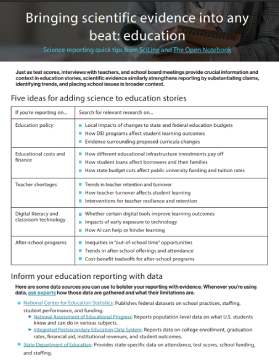
View printable PDF
| Ask economists about: • Returns on early childhood education programs • School voucher program outcomes • Labor markets for different college degrees • Family socioeconomic status and school attendance • College tuition increases and enrollment |
Ask epidemiologists about: • School nutrition programs • Air quality in schools • Extreme heat and outdoor activities • School sports and safety • Infectious disease spread in schools |
| Ask psychologists about: • Social emotional learning • How children learn to read • Learning differences and accommodations • Bias in grading and discipline • Evidence backing academic interventions |
Ask technology experts about: • AI policies in schools • Digital literacy • Science of learning games • How classroom technologies compare with analog options • Virtual learning outcomes |
Further reading: Talking to students and other young people as sources, After school program benefits, Connecting school infrastructure to climate change.
This tip sheet was co-created by Tori Espensen (SciLine) and Rachel Zamzow and Kate Fishman (The Open Notebook). Special thanks to Missouri School of Journalism graduate student Tyanna Jackson for research.